NGC 4631 is a spiral galaxy in the northern constellation Canes Venatici (the hunting dogs) seen edge-on. It is one of a close trio of bright galaxies; two of which are visible in this image. All three have been graviationally ‘involved’ with each other in the past. That interaction is evident in the distortion of the large galaxy visible here and the third galaxy off the image to the lower left. The asymmetry about the central bulge and the prominent bright region of newly forming stars on the lower left edge has given the galaxy the common name of ‘The Whale Galaxy’.

“]

The Whale Galaxy (NGC 4631) [C:30x120s

This image is a stack of thirty 120 second exposures taken on the evening of the 26th of March. The dimmest star in this image is a magnitude 20.3 and nothing in this image is visible to the naked eye. Unlike most of my imagery, north is up and east to the left.


The great English astronomer William Herschel first used the term globular cluster (derived from the Latin globulus – little sphere) in 1789. Globular clusters are, usually, very distinct. Thousands to a million stars packed into a tight spherical area is the defining visual characteristic. Located in the constellation Coma Berenices ( Berenices Hair) NGC 5053 doesn’t look the part of globular cluster, but numerous spectroscopic analyses show that it is. NGC 5053′s height above the galactic plane and the lack of metals in its stars also indicate it is globular in nature. In 2006, a study found a faint 6 degree tidal tail indicating that its close path to the Milky Way may be responsible for the dispersed nature of the cluster.

“]

(NGC 5053) [C:56x30s

Nothing in this image is visible to the naked eye.

I took this image on the 17th of March. The image is a stack of 56 thirty second exposures and as usual north is to the right, east is up.


During their recent visit, guest observers Marie and John W. commented that the Pear Tree Observatory was not the first observatory they had toured.  They then sent me some photos of their 2005 field trip to the Parkes Radio Observatory in New South Wales, Australia.  First brought on line in 1961, the observatory is still in active service as part of the Commonwealth Scientific and Industrial Research Organisation’s (CSIRO) Australia Telescope National Facility.  The 64 meter dish at Parkes along with sister observatories Honey Suckle Creek and Tidbinbilla supported the Apollo 11 mission to land man on the moon, with Parkes ultimately providing the primary reception of the TV signals transmitted by Eagle. 

Quite often, pictures of large radio telescopes are taken from enough distance to include the entire dish.  This makes it difficult to visualize the size of the facility, but this photo really puts the enormity of the main reflector in perspective.  Marie also included a photograph of an original control console used during the mission currently on display in the observatory museum. 

Finally, the observatory is also the star of the 2000 movie “The Dish” starring Sam Neil.  The movie portrays a Hollywood version of the people and events surrounding the observatory’s support of the moon landing.

Many thanks to Marie and John for sharing their photos.


“]

[C:1x300s

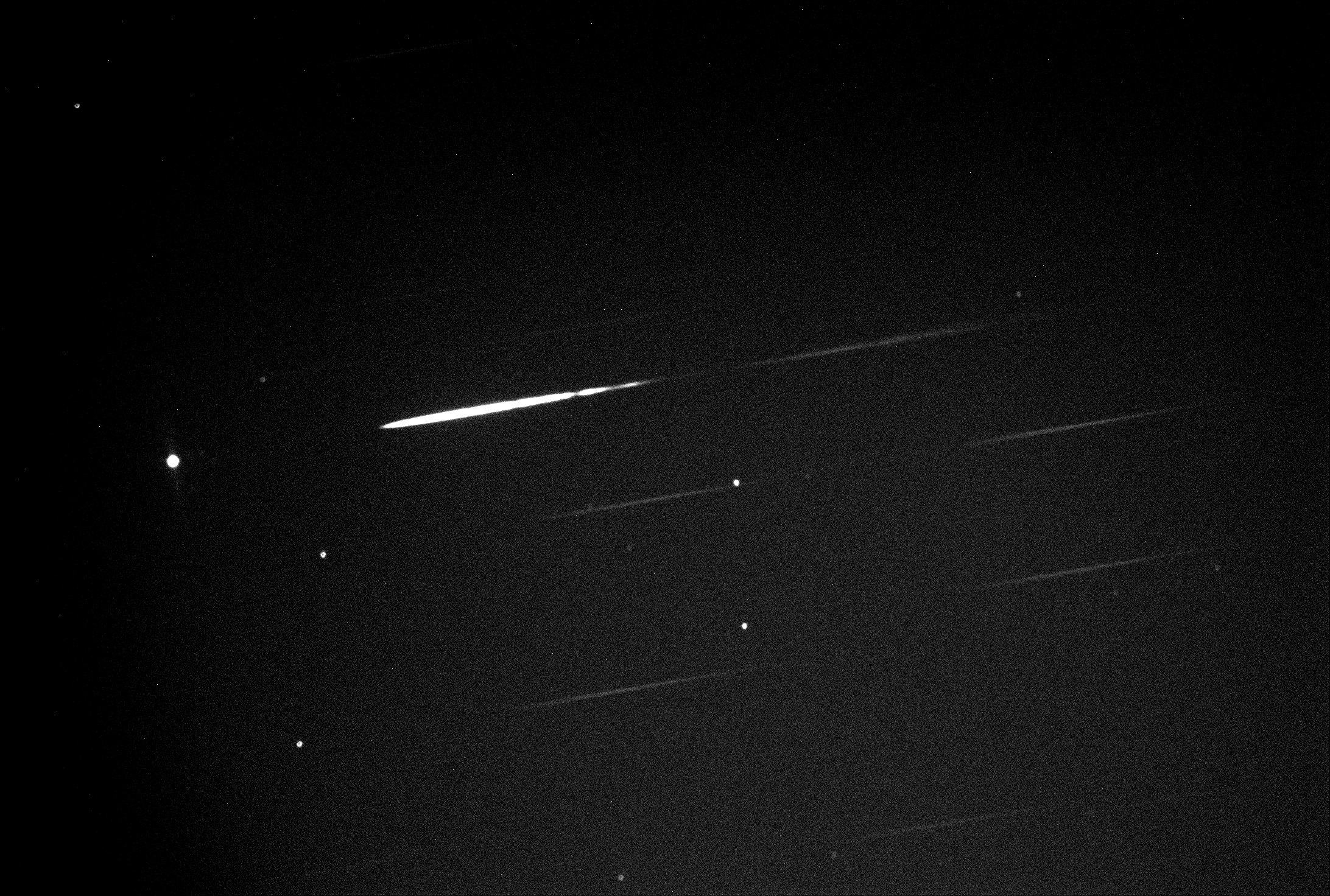
While the nebulous streaks that run through this image are reminiscent of sections of the Veil Nebula, they are probably much more mundane in origin.  This  image is one from a set of nine and across the 45 minute time span, the band slowly drifted a small distance from left to right (South to North).  A couple of sources come to mind.  One would be the remains of an aircraft contrail, or it may be a very persistent meteor train.  My guess is these are the remains of an aircraft contrail.  There was nothing visible in the sky to confirm this guess.  This is not the first of these I have recorded, but this one has the most interesting internal structure.


In 1949, when Edwin Hubble was given the honor of taking the first photograph with the new 200″ Hale telescope at Palomar Observatory, this is the object he chose.  It is a reflection nebula lit by a nearby star that he had studied earlier in his career at Yerkes observatory.  What makes this nebula so interesting is its ability to visibly change appearance over the space of several weeks.  The current theory for the rapid visual change is dense dust clouds orbit the star and during their orbit pass between the star and the nebula.  We see the changing shadows the dark clouds cast onto the nebula.

“]

Hubble's Variable Nebula (NGC 2261) [C:30x10s

The nebula and its associated variable star are both located in the constellation Monoceros (The Unicorn). Variable stars are cataloged by letter designation. Historically, the first identified in a constellation was given the letter ‘R’.  The subsequent discoveries were given ‘S’ through ‘Z’.  The letter designation is combined with the genitive form of the name of the constellation the star is in.  The variable star that lights up Hubble’s Variable Nebula is R Monocerotis.  Most constellations have so many variable stars that the alphabet runs out of letters.  Once that happens a more complex system is used to name them.

This image is a stack of 30 ten second exposures taken on the 2nd of January.

© 2011 Pear Tree Observatory Suffusion theme by Sayontan Sinha